


Visiting Odesa had been a childhood dream of mine. My uncle spent many holidays here in the 1970s and was always raving about the city. His stories had stayed with me.
In 2021, while travelling in Transnistria, I had come very close to Odesa but, unfortunately, didn’t take the time to visit. Then the war started, and Odesa suddenly seemed much farther away.
In July 2026, while visiting my friend Natalia in Chișinău, I noticed just how much traffic there was between Moldova and Ukraine. Buses for Odesa were leaving every 30 minutes. Eventually, I got on one too.

Odesa’s pastel coloured buildings
Travelling from Chișinău to Odesa
The trip from Chișinău to Odesa takes about four and a half hours, including the wait at the border—which, in my case, was incredibly short. On the Moldovan side, the bus driver collected the passports of all the passengers. Soon afterwards, we got them back. At Ukrainian immigration, we did not even have to get off the bus.

Sign on bus heading towards Odesa from Chisinau
Moldova and Poland are two of Ukraine’s friendly neighbours and important routes to the West. For Ukrainians living in the south of the country, Moldova has become particularly important. The road from Chișinău to Palanca, the border crossing with Ukraine, is mostly a two-lane road. At one point it crosses a bridge, a reminder of how vulnerable this important connection is and how easily it could be interrupted.

Palence is the most popular border crossing into Ukraine from Moldavia
Along the way, I saw a large number of trucks. Later, I was told that since the port of Odesa became a target of Russian missiles and drones, more grain and other goods have been transported by road.
The route is also in high demand among ordinary travellers. Buses leave Chișinău for Odesa roughly every 30 minutes, and many Ukrainians travel back and forth. Moldova has taken in a large number of Ukrainian refugees relative to its small population, making the movement of people between the two countries a part of everyday life.
video
Every bus also stops at Chișinău International Airport, which lies on the way towards Palanca. Since civilian air travel in Ukraine stopped after the start of the war, Chișinău has become the nearest major functioning airport for people travelling to and from Odesa and much of southern Ukraine.

Chisinau Airport – Ukrainians waiting for the Odesa bus

Border Moldova- Ukraine
The journey itself is surprisingly straightforward. But the busy buses, endless trucks and strategic road to the border are constant reminders that this is no longer simply a route between two neighbouring cities. It has become an important link between southern Ukraine and the outside world.
Arriving in Odesa a German Stammtisch and a night full of unfamiliar sounds
As soon as the bus spat me out at Odesa’s rather grungy bus station, Google Maps on my phone went crazy. Instead of showing me where I was, all I could see was a large blue circle hovering somewhere over the centre of Odesa.
Very annoying, since I had to walk about 1.5 kilometres to my hotel. I had no Ukrainian currency, wasn’t familiar with the public transport system and didn’t have a taxi app.
Only later did I learn that this was one of the first indications that I had arrived in a country at war. GPS signals can be disrupted during air-raid alerts.
For someone just arriving in Odesa, however, the war is not immediately visible. The city functions. The streets are busy, restaurants are full and public transport is running. At first sight, there is little to suggest that you are in a city regularly targeted by Russian missiles and drones.

Restaurant in Odesa
There had already been a small hint when I booked my hotel online. Along with the reservation came a note:
“Please read carefully: the hotel is equipped with a shelter and has a reliable power supply because it is equipped with powerful generators.”

German Stammtisch in Odesa
For years, I have been a member of a WhatsApp group called “Friends of Ukraine.” When I mentioned that I was heading to Odesa, someone sent me a private message:
“Go to the Biergarten im Gorsad. The German Stammtisch meets there every Wednesday, at a restaurant called Pyvnoy Sad.” And, as luck would have it, the day I arrived in Odesa was a Wednesday.
That evening turned into an unforgettable introduction to the city. I met Germans living in Odesa as well as German-speaking Ukrainians, and the evening was full of stories and conversations. By the time I left, I had received so many invitations to meet people again that I immediately knew I would be staying for a while.
Someone also recommended an app that would warn me of air-raid alerts. But that same evening, I learned something else about life in Odesa.

alerts through apps arrive constantly
I was surprised by how little the people around me seemed to react when an alert sounded. No matter how loudly or how long the sirens wailed, people generally carried on with whatever they were doing, perhaps taking a quick look at their phones before returning to their conversations.
Earlier, in the hotel elevator, I had noticed a sign:

Sign in Elevator warning not to ignore alerts
At the time, it had seemed like an unnecessary instruction. Now I understood why it was there.
Exploring Odesa with Tim from Rügen
My first night in Odesa became a continuous sequence of booms and detonations. Having seen how locals responded to air-raid alerts, I decided to do the same and carry on with what I was doing.
I stayed in bed. Besides, I didn’t even know where the nearest shelter was.
At the time, I had no idea what the sounds meant.
sound aufnahmen einfügen
The next morning, Tim picked me up. He had grown up on the German island of Rügen and had been living in Odesa for four years. Almost the first thing he said was: “This was the worst night since the beginning of the war.”
That put my first night in Odesa into perspective.
The next thing I learned was that many of the sounds I had been hearing throughout the night were Ukrainian air defences at work.
Then, with Tim as my guide, I plunged into a fascinating city that, at first sight, showed remarkably few visible signs of war. We climbed aboard an old streetcar and set off.

Tim orginally fron Rügen has lived in Odesa for 4 years

Streetcar in Odesa
Pryvoz Market
Our first stop was Pryvoz Market, a feast for both the eyes and the palate, overflowing with fruit, vegetables, meat, fish, cheese and just about everything else imaginable, much of it at prices that seemed almost unbelievable to a visitor from Western Europe.

Entrance to Pryvoz Market
Ten eggs cost around one euro. And eggs were not simply eggs: vendors even displayed a cracked one so you could inspect the colour of the yolk before deciding what to buy.

10 eggs for €1

Wine section in Pryvoz Market

Fish section of Pryvoz Market- sturgeon
The meat section was another experience altogether. Let’s just say that committed vegetarians might prefer to move through it rather quickly.

Meat section in Pryvoz Market

Meat section in Pryvoz Market

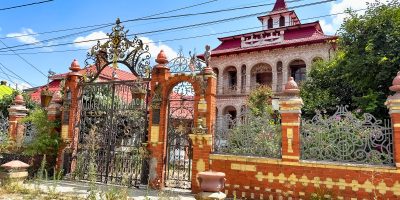
I loved Odesa most for its candy-coloured houses. Soft pinks, buttery yellows, faded blues and pistachio greens line its streets, giving the city an elegance that feels both grand and slightly worn around the edges.

Pastel-coloured houses of Odesa- my absolute favorite sight
Odesa’s architecture tells the story of the city itself. In 1794, Empress Catherine II ordered the establishment of a port here on the Black Sea, part of the Russian Empire’s drive to develop a warm-water trading port. Commerce brought prosperity, and with it came people from across Europe and the wider Black Sea region.

Pastel-coloured houses of Odesa- my absolute favorite sight
Greeks, Jews, Italians, French, Bulgarians, Ukrainians, Russians and many others made their homes here, shaping Odesa into one of the Black Sea’s great cosmopolitan cities. By the years before Russia’s full-scale invasion of Ukraine, the city was home to people representing more than 100 nationalities.
The Port of Odesa
Tim lives near the port of Odesa, an area particularily effected by the attacks. The port and its infrastructure have repeatedly been targeted by Russian missiles and drones. The container terminal also has a German connection: it is operated by a company belonging to Hamburg-based HHLA. Ukrainian air-defence positions sit on the steep hillsides running down towards Odesa’s harbour. These areas are cordoned off, and people seem to respect the restrictions without question. There are also mobile air-defence units that move around the city, responding to incoming threats.

View down to the Port of Odessa
Grain exports make the port particularly important. Ukraine is one of Europe’s major agricultural producers, and keeping its Black Sea export routes functioning matters far beyond Odesa itself.
I had already seen another part of that story from the window of my bus from Chișinău: the seemingly endless procession of trucks travelling between Moldova and Ukraine. Road transport provides an alternative route when shipping is disrupted, but its capacity is nothing like that of a major seaport.
And the road itself had struck is vulnerable. Much of it is only two lanes wide, and near the border, it crosses a bridge. Some of my friends had wondered why such infrastructure had not been targeted. It was an unsettling thought.
If Ukraine’s Black Sea shipping routes were severely disrupted at the same time as important overland connections, the consequences would reach far beyond Odesa. For one of Europe’s largest grain-producing countries, reliable access to export routes is not merely an economic issue. It is a lifeline.
The Beaches of Odesa
Another place I fell in love with was Luzanivka Beach. A small iron gate gave access to a beach that was still partly closed. Its long, flat stretch of coastline could potentially be used for an amphibious landing.

Luzanivka Beach partly closed, its flat coastline could be used for an amphibious landing.

Luzanivka Beach partly closed, its flat coastline could be used for an amphibious landing.
It was a cloudy, slightly gloomy day, but music blasting from a fast-food stand did its best to lift the mood.
Video
For several years, much of Odesa’s waterfront had been shut down. Hotels, restaurants and other businesses closed, and although they were slowly waking up again, parts of the area still looked neglected and worn down.

Hotel that has Seen better days
Most visitors seemed to prefer beaches such as Otrada and Arcadia, where the hotels are more expensive and the nightlife considerably livelier.
There were, in fact, surprisingly many tourists in Odesa. But perhaps that shouldn’t have surprised me. Crimea was off limits, while the beaches around Kherson were far too close to the front. For Ukrainians wanting a holiday by the Black Sea, the choices had become limited.

Tourists from Kyiy
While we were at Luzanivka, another air-raid alert sounded. Once again, nobody headed for a shelter. Life simply continued.

Luzanivka Beach in Odesa
Otrada Beach
Five-star hotels sit at the top of the hill, while the beach is quite a hike below. Which is probably why someone, at some point, thought it would be a good idea to build a little cable car.
Nobody seemed to be using it. Except me. Perhaps the lack of passengers had something to do with the €4 fare. Or perhaps it was the rather frail appearance of the thing. Either way, I got in.Video
Video
Down at the beach, another air-raid alert began. The sirens wailed and wailed. The beach was crowded, but nobody stopped swimming. People continued talking, sunbathing and enjoying the Black Sea.

Otrava Beach

Otrava Beach during alert
Only one family from Kyiv stood near the shelter, looking around as if they weren’t quite sure what they were supposed to do.

a family near the shelter not knowing what to do
Apart from the sirens, there was another reminder of the war. At a stall on the beach, volunteers were teaching people how to stop severe bleeding—first-aid skills that have acquired a very different relevance in Ukraine.
video – stop bleeding
Naturally, I filmed it and put it on Instagram, like the Ukrainian tourists.
Before I left Chișinău for Odesa, friends had warned me about swimming in the Black Sea. Naval mines had broken loose during the war and washed up elsewhere along the Black Sea coast, including in Romania.
Yet one of the tragedies I heard about in Odesa involved a danger coming not from the sea, but from the sky. A young woman on a beach was struck by debris from a downed drone, suffering a fatal injury.
news article
I never made it to Arcadia, Odesa’s beach district famous for its nightlife. Another good reason to return.
Meeting People Who Make a Difference
I met the most wonderful people in Odesa. People who invited me into their homes, showed me around and took me to places I would never have discovered on my own.
One of them was Manfred, whom I met at the local German Stammtisch. He grew up in a German-speaking village in Romania. When he was twelve, his family moved to Germany, where he later ran a successful car-repair business. After retiring, he settled in Ukraine and married Iryna.

House of Manfred and Iryna

View of Manfred’s and Irinas home
One evening, Manfred and Iryna invited me to their enormous villa overlooking a lake outside Odesa. Afterwards, they took me to Yakhta Beach, a popular beach complex near the village of Fontanka, for dinner.

Iryna and me on Yakhta Beach, with dinosur in the background

Yakhta Beach
It has just about everything you could want for a family day—or night—out: a beach, swimming pools, restaurants and entertainment.
And dinosaurs. Lots of dinosaurs.
They are scattered all over the place. Some of them even move and attempt, mostly unsuccessfully, to frighten the children.
video
On the way, we made another unexpected stop: a genuine “lost place,” an abandoned former sanatorium. Once intended as a place of rest and recovery, it now stood empty and slowly decaying. It was one of those places I would never have found without someone local showing me around.

Abandoned Sanatorium
The Only Time I Went to a Shelter
During an outing with Iryna and Manfred, I sought refuge in an air-raid shelter for the first—and only—time during my stay in Odesa.
We were in the car when an incredibly loud detonation shook the city. Iryna immediately became alarmed and kept repeating a word I couldn’t understand. Eventually, she managed to explain that she believed a particular type of missile was approaching.
She insisted that Manfred stop the car immediately so we could find shelter. But we were stuck in traffic, so I got out with her and we hurried into a nearby hotel.
“Can we use your shelter?” Of course we could.

Inside a shelter with Iryna
Like many shelters, it was essentially a windowless room inside the building. The moment we were inside, Iryna relaxed and before long we were outside again.
That day, Iryna also told me about the winter of 2025, when parts of the city were without electricity for days.
She and Manfred had generators at their house, but many others had neither electricity nor heating. Elderly people living in high-rise apartment buildings were particularly affected.
Without power, the elevators stopped working. So did the pumps supplying water to the upper floors. For some residents, this even meant suchs basics as flushing the toilet became impossible.
Stories like Iryna’s left me with enormous admiration for the resilience of the people I met in Ukraine. “Resilience” is a word that is easily used from a distance. In Odesa, I began to understand what it can mean in everyday life.
An Afternoon with Karina
Through Manfred, I also met Karina, a German teacher at a high school in Odesa. We spent an afternoon together and met some of her students.
One of them told me how much the constant air-raid alerts disrupt their education. Every time an alert sounds, the students have to leave the classroom and move to the shelter. When this happens repeatedly, serious studying becomes almost impossible.

Karina, her student Valentina and moi
She also described another difficulty of growing up in wartime: parents deal with the danger very differently. Some have become relatively relaxed about the daily alerts and allow their children a fair amount of freedom. Others are much more cautious and hardly let them leave the house.
Listening to these young people, I couldn’t help feeling sorry for them. They had only just escaped from the restrictions and isolation of the Covid years, when Russia’s invasion turned their world upside down once again.
With Karina I visited an art fair. Even there, the war is never completely absent.

Art Fair in Odesa
Among the paintings, handicrafts and people enjoying their afternoon were volunteer stalls collecting donations and raising money for things urgently needed in wartime. Tourniquets were among the items on display—a small object with the very serious purpose of stopping catastrophic bleeding and potentially saving a life.

donations are collected everywhere and training provided to stop bleeding
It was another of those contrasts I encountered again and again in Odesa. People go to art fairs. They meet friends. They go out for dinner. Children play among mechanical dinosaurs. And somewhere among all this ordinary life are reminders of a war that has become part of everyday existence.
Karina is coming to Austria with some of her students in September, and I’m already looking forward to seeing her again.
These are the moments I will remember most from Ukraine.
Not only the places I visited, but the people. Their generosity. The invitations into their homes. The conversations over dinner. The stories of lives interrupted, changed and adapted.
And that strange coexistence I encountered everywhere in Odesa: beaches and air-raid sirens, art fairs and tourniquets, dinners with friends and conversations about the war. Life continues. But the war is always there.
Where War and Party Collide
Perception also varies enormously depending on where you are. A Ukrainian friend told me, “When you live in Lviv, Odesa is hell. When you live in Kharkiv, Odesa is paradise.” The security situation differs dramatically from one region of Ukraine to another.
One place where the brutality of the war becomes very real is a small outdoor exhibition on Kulikovo Field in Odesa.

Kulikovo Field in Odesa-

Since last April, captured and destroyed Russian military equipment has been displayed there.
One of the captured Russian tanks was completely riddled with bullet and shrapnel holes. One of the holes was so deep that I could stick my entire finger into it without reaching the end. It gave me a striking sense of just how thick the tank’s armor is—and of the force of the ammunition used against it.
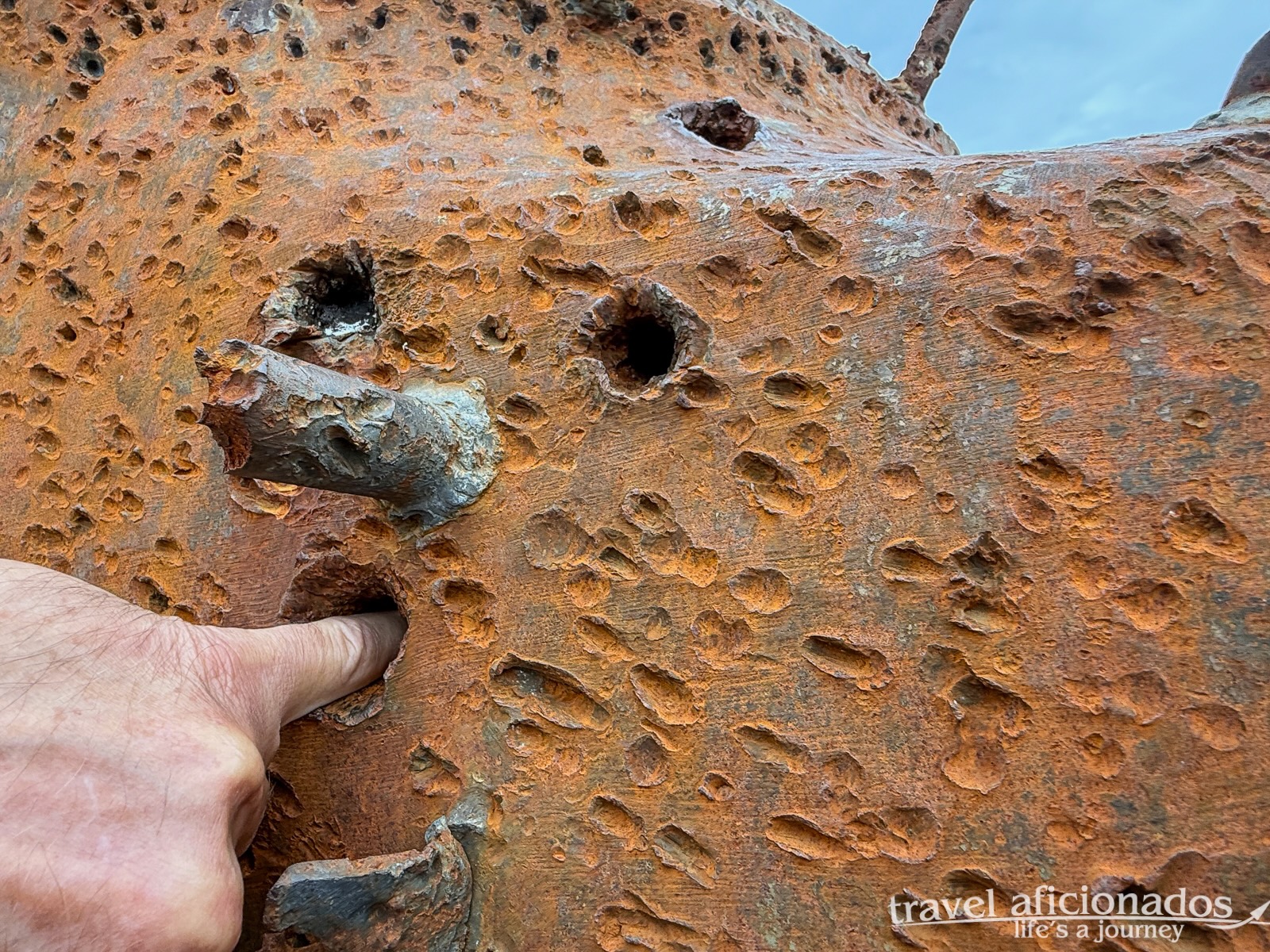
Conquered Russian tanks riddled with bullet holes
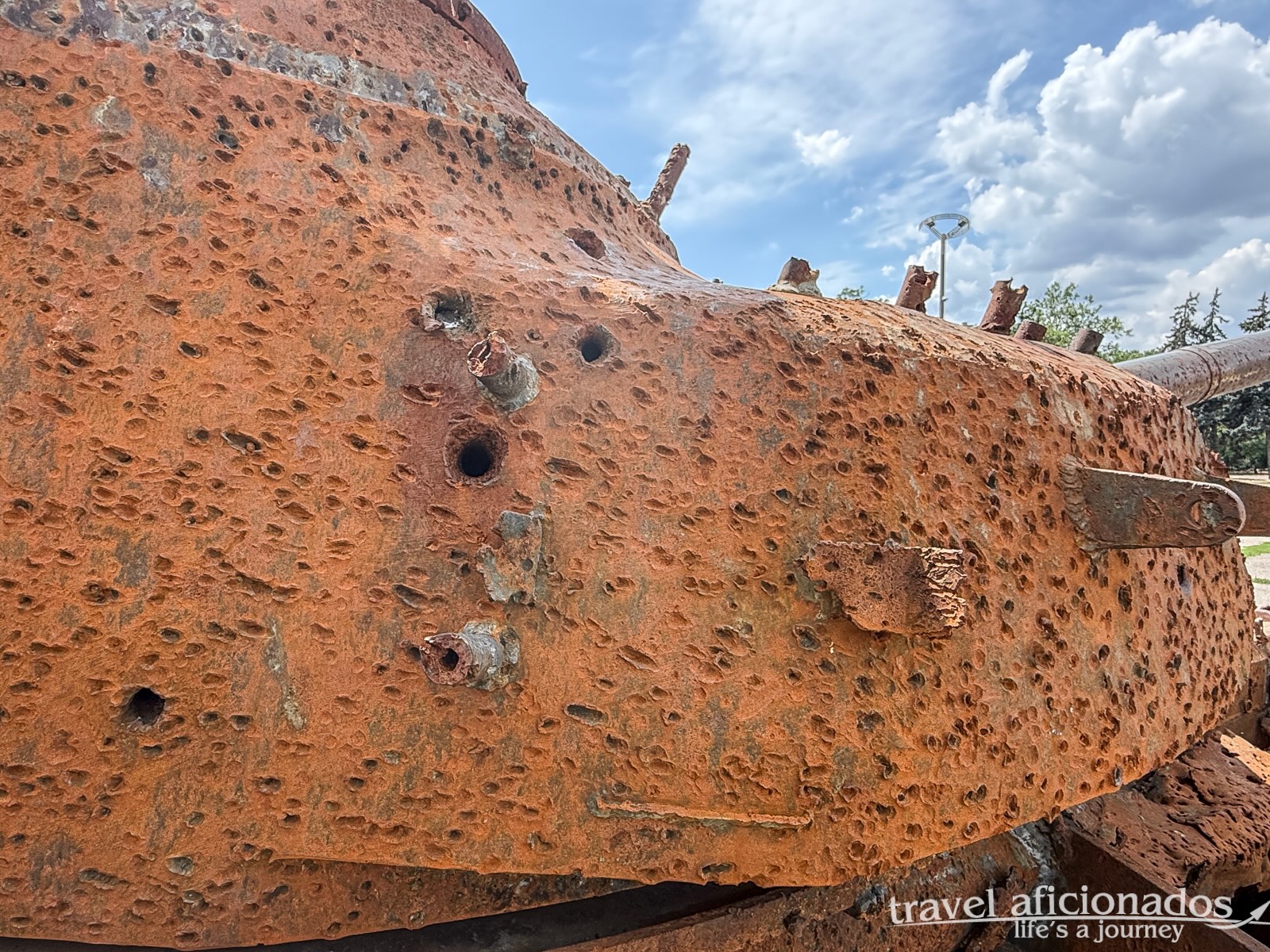
Conquered Russian tanks riddled with bullet holes
Also on display were drones, including the remains of a Shahed drone.
These drones were originally produced by Iran and powered by engines similar to those used in lawnmowers, which explains their typical sound. Russia has since further developed them, including versions equipped with jet engines. These are much faster than the original Shaheds, leaving air-defense teams with significantly less warning time and making them more difficult for mobile anti-aircraft units to intercept.

Shahed drone
What struck me again and again during my time in Ukraine was this contradiction: a country at war, grieving and fighting—yet at the same time refusing to give up on life.
So, on a weekend, I went to check out Odesa’s nightlife, which ends at midnight because of the nationwide curfew.
video
Odesa’s Party scene
The most popular area is around the pedestrian zone. Ironically, the main police station is located there as well. Locals told me that the police sometimes have to enforce the curfew and that clashes with young people who want to continue partying are not uncommon. That’s why most restaurants close around 10pm, so that everybody is out long before midnight.

Main Police Stadtion near party Zone
Also on the rooftop restaurant “in the clouds” the war seems very far away. It is packed with people, although rather prices, the food is ok, the service lousy, but the view unbeatable.
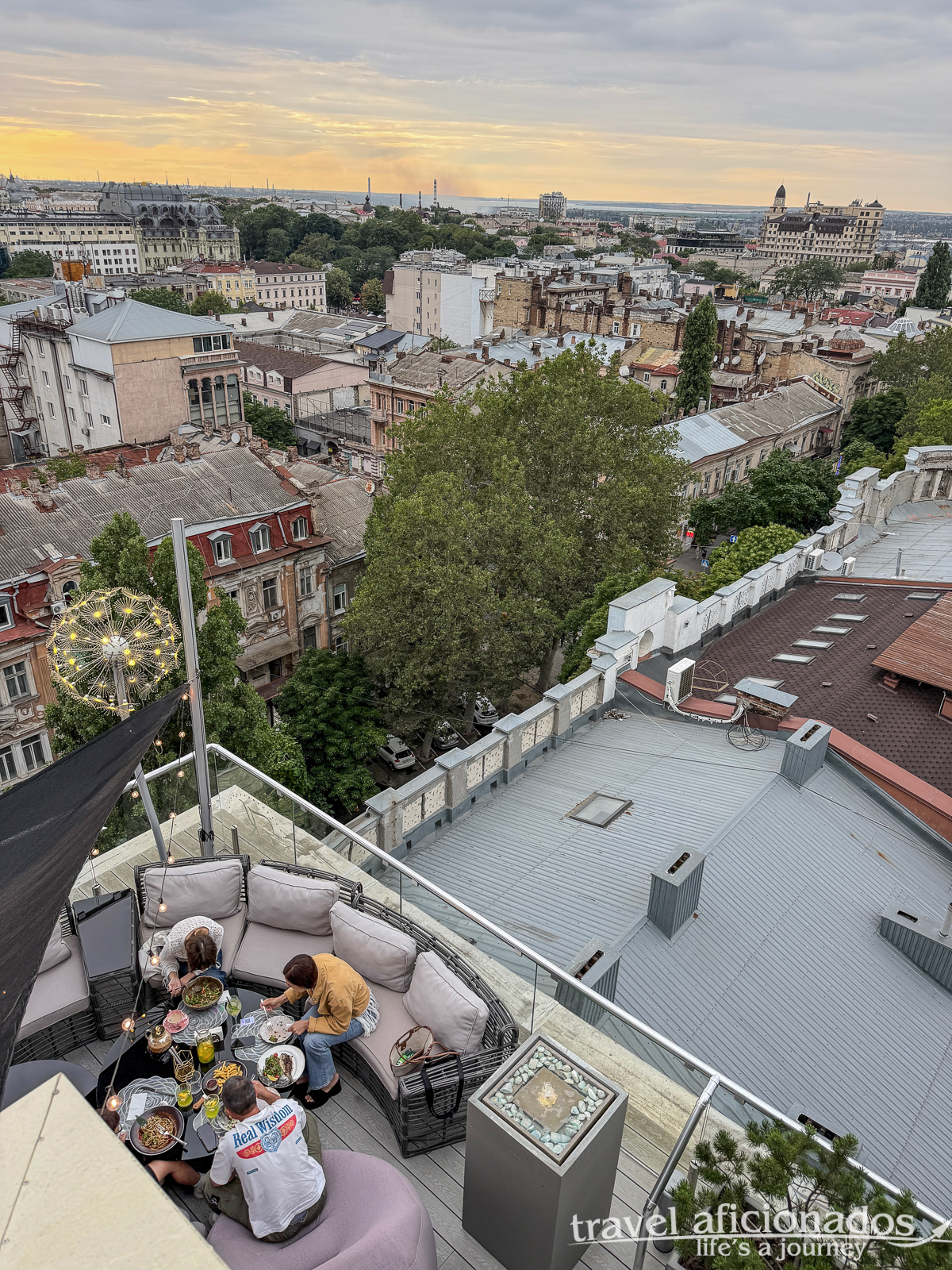
Oblanka rooftop restaurant “in the cloud”

Terrace of Oblanka rooftop restaurant

Inside Oblanka restaurant
Starokonka: Odesa’s Flea Market
After a few days in Odesa, I felt comfortable enough to venture farther out and explore some of the city’s less obvious corners. I love flea markets, so off I went to Starokonka, in the Moldavanka district.
Starokonka is definitely not a place for anyone particularly sensitive about animal welfare.

Starokonka: Odesa’s Flea Market

Starokonka: Odesa’s Flea Market
The market stretches across several blocks, and you can find pretty much everything there: clothes, cables, crocheted goods, surgical instruments, knives, plants, vegetables, mountains of kitsch—and all sorts of things whose purpose I couldn’t begin to guess.

Starokonka: Odesa’s Flea Market

Starokonka: Odesa’s Flea Market
And then there are the animals.
That was the part of Starokonka I found hardest to forget.
Vendors sit along the pavement with their “merchandise” lined up in front of them. Some were selling entire litters of puppies; others had individual dogs, usually bigger and older.
The puppies were kept in cages, some dressed in cute little outfits. A few vendors tried to encourage them to move around and play with toys, presumably to attract potential buyers. But in the summer heat, many of the poor animals seemed too exhausted to do much of anything. They simply slept.

Pet section in Starokonka: Odesa’s Flea Market
What disturbed me most were the dogs being displayed in the open trunks of cars. Some lay on blankets, panting heavily in the heat and looking completely exhausted.
There was a strange contradiction in the way the animals were treated. Despite the conditions in which they were being displayed, the sellers could be extremely cautious when potential buyers wanted to touch a puppy. Before picking one up, they first had to disinfect their hands.

Apparently, some precautions mattered more than others.
As I continued wandering through the market, the air-raid alert went off.
This time, it wasn’t just the familiar siren. Announcements over loudspeakers instructed people to go to the shelters.
By now, I knew what would happen.
A few people glanced at their phones, presumably checking the air-raid app to see what kind of threat had triggered the alert—a drone, perhaps, or a missile.
And then they went back to what they were doing.
Nobody packed up the market. Nobody rushed away. People continued bargaining, browsing and selling.
And Starokonka carried on as before.






Leave a Reply